

The Fintech 5 with Michelle Bonat — Chief AI Officer at AI Squared

The Fintech 5 is a series of blog posts consisting of questions and answers designed to help you get to know the people in the Fintech Sandbox community.

Michelle Bonat, CAIO at AI Squared, merges finance and technology expertise to spearhead AI initiatives. With an MBA from Kellogg, she founded a fintech startup, led AI innovation at Chase Bank, and patented her technology. At JPMC, she served as AI CTO, driving transformative projects. Her career includes time as a software executive at Oracle, and product leadership at Ariba and startups, showcasing her strategic prowess. Passionate about diversity, she mentors, judges, and teaches coding to underrepresented groups. A sought-after speaker, she addresses AI, tech, and innovation. Bonat’s leadership at AI Squared reflects her commitment to solving impactful problems with AI and data, delivering cutting-edge solutions for enterprises. Her career trajectory underscores her vision and execution capabilities honed over years of experience in technology and finance.

Michelle Bonat

Question #1:  Michelle, what is an AI Playbook and why is it important?

Recently, I created an AI Playbook that can be used by any organization. An excerpt of this playbook is below. You can find more details here.

A Step-by-Step Guide to Creating your Organization’s AI Playbook: Boat or Moat?

This AI playbook helps you determine if your AI strategy should be geared towards more of a boat (advancing your position) or a moat (defending your position).

An AI playbook is a strategic document that outlines an organization’s approach to implementing and leveraging artificial intelligence (AI) technologies. It includes a series of steps, best practices, and guidelines for integrating AI into various aspects of the business.

Here are some key components that should be included in a organization’s AI playbook:

  1. Business Objectives and Use Cases: Define AI objectives, identify use cases, prioritize based on business needs, develop a rating system, revisit monthly, evaluate quarterly.
  2. Data Strategy: Establish a comprehensive data strategy covering collection, governance, quality, storage, privacy, and security. Ensure ethical compliance and quality management.
  3. Ethical and Regulatory and Governance Considerations: Establish ethical AI guidelines, conduct risk assessments, engage stakeholders, ensure regulatory compliance, and establish model governance procedures.
  4. AI Development Lifecycle: Define your AI lifecycle: ideation, data prep, model dev, testing, deployment, monitoring. Specify team roles.
  5. Model Selection and Evaluation: Define criteria for AI model selection, evaluation metrics, and validation procedures. Specify rules for use of external services like ChatGPT.
  6. Implementation Roadmap: Implement AI in phases with timelines, milestones, and resource allocation. Pilot, scale, iterate based on feedback. AI relies on circular development cycles.
  7. Ethical and Responsible AI Principles: Embed ethical AI principles: fairness, transparency, accountability, bias mitigation in development and deployment. Enforce these principles.
  8. Risk Management and Compliance: Identify AI risks: legal, regulatory, reputational, operational. Develop mitigation strategies, ensure compliance.
  9. Security and Privacy Measures: Utilize secure AI: safeguard data, systems from cyber threats, breaches. Use privacy-preserving techniques, encryption.
  10. IP Protection: Define your IP strategy: Copyrights, Trademarks, Patents, Open Source. Determine an offensive or defensive patent approach. Choose license options.
  11. Cross-Functional Collaboration: Encourage cross-departmental collaboration: data scientists, engineers, analysts, legal, stakeholders. Define team structures and communication.
  12. Training and Capacity Building: Offer AI training: workshops, resources, certifications. Empower staff with skills for effective AI use.
  13. Continuous Improvement and Optimization: Establish continuous improvement for AI: feedback loops, performance monitoring, refinement based on real-world usage. Ensure auditable processes.
  14. Documentation and Knowledge Sharing: Share AI best practices, lessons, case studies. Create repositories for code and models. Consider an internal data, feature, and model sharing marketplace.
  15. Stakeholder Communication and Engagement: Engage stakeholders: employees, customers, partners, regulators, media. Promote transparency, trust. Educate on AI processes. Hold monthly updates.

By incorporating these components into a comprehensive AI playbook, your organization can establish a structured and disciplined approach to AI governance and maximize the value and impact of your AI investments while mitigating risks and ensuring ethical and responsible AI deployment. By completing this playbook your optimal approach “Boat” vs “Moat” becomes more clear. This playbook is a living document that grows with your organization.

#2.  How do we keep historical biases out of generative AI?

Thank you for this question! Keeping historical biases out of generative AI is a complex challenge that requires a multi-faceted approach. Here are some strategies to keep it on point:

  1. Diverse Training Data: Ensure that the training data used to train the AI model is diverse and representative of different demographics, cultures, and perspectives. Use training data that reflects your customers. This can help mitigate biases that may arise from a narrow or skewed dataset.
  2. Bias Detection and Mitigation: Implement techniques to detect and mitigate biases in the training data and model outputs. This may involve using fairness-aware learning algorithms and techniques such as adversarial debiasing or counterfactual data augmentation.
  3. Human Oversight and Evaluation: Incorporate human oversight and evaluation throughout the development process to identify and address biases. This can involve expert review, bias audits, and user testing to assess the fairness and inclusivity of the AI system. Consider red teaming, a method of testing AI models to identify vulnerabilities and prevent harmful behavior,
  4. Transparency and Accountability: Promote transparency in the AI development process by documenting data sources, model architectures, and decision-making processes. Establish clear accountability mechanisms to address instances of bias and ensure responsible AI deployment.
  5. Bias Impact Assessment: Conduct thorough impact assessments to understand how biases in the AI system may affect different groups and communities. Take proactive measures to mitigate potential harms and ensure equitable outcomes.
  6. Continuous Monitoring and Updating: Implement systems for continuous monitoring and updating of AI models to identify and address biases that may emerge over time. This may involve collecting feedback from users and stakeholders and retraining the model with updated data.
  7. Ethical Guidelines and Standards: Adhere to ethical guidelines and standards for AI development, such as those outlined in frameworks like the IEEE Global Initiative on Ethics of Autonomous and Intelligent Systems or the Principles for AI developed by organizations like the Partnership on AI. Get familiar with the recently passed EU AI Act. While the scope for this is currently Europe, we expect it to be adopted at some point globally, much like GDPR got its start in Europe.

By incorporating these strategies into the development and deployment of generative AI systems, we can work towards minimizing historical biases and promoting fairness, diversity, and inclusivity in AI applications.

#3.  What are the biggest risks arising out of generative AI in financial services? What do you worry about?

Generative AI in financial services holds great promise for tasks such as fraud detection, risk assessment, portfolio optimization, and customer service. These are “classic” use cases in financial services that have benefitted from including AI into these processes. Now with GenAI coming into use, we’re seeing organizations incorporating GenAI into these critical processes. However, there are numerous potential risks associated with the use of GenAI in organizations:

  1. Data Privacy and Security: Generative AI models trained on financial data may inadvertently expose sensitive information about individuals or organizations, leading to privacy breaches and security vulnerabilities. Using external foundation models and services like ChatGPT may exacerbate this. Make sure your organization establishes rules for usage of these external services.
  2. Algorithmic Bias: Biases present in the training data used to train generative AI models can lead to biased outcomes in decision-making processes, such as loan approvals or investment recommendations, potentially perpetuating or exacerbating existing inequalities. Particularly in finance, which is highly regulated, we need to pay attention to the origins of the training data.
  3. Model Robustness and Reliability: Generative AI models may produce outputs that are not sufficiently robust or reliable for critical financial decision-making, leading to errors or unexpected behaviors that could have significant financial consequences. This could create end user frustration and inaccurate or harmful results.
  4. Adversarial Attacks: Generative AI models may be vulnerable to adversarial attacks, where malicious actors manipulate input data to produce undesirable outcomes, such as generating fake transactions or bypassing fraud detection systems.
  5. Regulatory Compliance: The use of generative AI in financial services may raise regulatory concerns related to transparency, accountability, and compliance with laws and regulations governing financial transactions, data protection, and consumer rights. Imagine talking to a regulator and explaining the the output given to a customer or employee may be different every time.
  6. Systemic Risk: If widely adopted, generative AI models could introduce new sources of systemic risk to financial markets, such as amplifying market volatility or creating unforeseen correlations between assets.
  7. Ethical Considerations: The deployment of generative AI in financial services raises ethical questions about fairness, accountability, and the potential impact on individuals and society, particularly in terms of financial inclusion, access to credit, and the distribution of economic opportunities.

To mitigate these risks, financial institutions should implement robust governance frameworks, adopt best practices for data management and model validation, invest in cybersecurity measures, prioritize fairness and transparency in AI development, and engage with regulators and stakeholders to address regulatory and ethical concerns. Beyond this, ongoing research and collaboration between industry, academia, and policymakers are essential to address emerging challenges and ensure the responsible and ethical use of generative AI in financial services. I’m happy to report that this collaboration is already underway.

#4.  If you could change one thing about the fintech ecosystem, what would it be?

If I could change one thing about the fintech ecosystem, it would be to systematically and permanently enhance financial inclusion on a global scale. Despite significant advancements in financial technology, there are still millions of people worldwide who lack access to basic financial services such as banking, credit, and insurance. This lack of access perpetuates economic inequality and limits opportunities for individuals and communities to thrive. While I was at JPMorgan Chase. I was so impressed with the strides the company took to work on this, yet there still remains an enormous amount to be done.

To address this, I would focus on:

  1. Developing Solutions for Under-Served Populations that are economically viable for the ecosystem: Encouraging fintech innovation that specifically targets under-served populations, such as the unbanked and underbanked, by providing affordable and accessible financial products and services tailored to their needs. This shouldn’t be a charity; it should function as a business.
  2. Improving Financial Literacy and Education: Investing in financial literacy programs and initiatives to empower individuals with the knowledge and skills to make informed financial decisions and effectively utilize fintech tools and services.
  3. Easing Regulatory Barriers while Maintaining Protections: Working with regulators and policymakers to create a supportive regulatory environment that fosters innovation while ensuring consumer protection and mitigating risks associated with fintech solutions.
  4. Promoting Collaboration and Partnerships: Encouraging collaboration and partnerships between fintech companies, traditional financial institutions, governments, NGOs, and other stakeholders to leverage their respective strengths and resources in advancing financial inclusion efforts.
  5. Harnessing Technology for Social Impact: Leveraging emerging technologies such as blockchain, artificial intelligence, and mobile connectivity to develop innovative solutions that address specific barriers to financial inclusion, such as access to credit, identity verification, and remittance services.

By prioritizing financial inclusion within the fintech ecosystem, we can work towards creating a more inclusive and equitable financial system that empowers individuals and promotes economic prosperity for all.

#5.  What fintech problem or solution are you focused on or most interested in right now?

I’m fascinated by a few opportunities in fintech and the broader ecosystem.

  • How enterprises can leverage AI safely, securely, and in a way that both leverages their own data and at the same time respects (and reflects) their own customers. I expect quality and efficiency tradeoffs we’re all making to improve. For example, should I use ChatGPT for my enterprise to quickly spin up a GenAI system, even if it may take my data? Should I use a foundation model to accelerate an AI experiment even if it may be biased and not reflect my customers, and possibly (probably) be trained on data that does not reflect my customers? Instead of LLMs (Large Language Models) think about SLMs (Small Language Models).
  • Empowering companies around AI regulation. In March of 2024, European lawmakers passed the first major regulatory act around AI (Read about it here). This EU AI Act is expected to take effect this summer for Europe. It provides ground rules to cover how AI is being used. It is the world’s first comprehensive legal framework for regulating artificial intelligence. The AI Act aims to create a safe, ethical, and transparent legal framework for developing, marketing, and using AI in the EU. The act also aims to foster innovation and investment in AI, improve governance and enforcement, and create a single EU market for AI. Similar to how GDPR resulted in global convergence on general data protection and transformed how US privacy laws protect consumers in the US, it is expected that this recent AI legislation in Europe will impact AI regulation in the US. This is an opportunity for entrepreneurs to assist with this regulatory lift.
  • How the fintech ecosystem can be more efficient and equitable with funding ideas. Fintechs and startups in general spend a lot of time connecting with funders, which is time spent they could be working on their business.

Bonus question! What is the best career or life advice you have received?

One of the best pieces of advice I’ve received is to embrace lifelong learning. In both career and life, the world is constantly evolving, and new opportunities and challenges arise. By committing to continuous learning and personal development, you not only stay relevant in your field but also open yourself up to new possibilities and growth opportunities.

I’m fortunate to be a Kellogg graduate, a school which embraces lifelong learning for their alumni. Recently I participated in the Kellogg Global Leaders Summit for alumni where we gathered for a few days in Miami to share learnings, and I was proud to give back and speak to this community about AI.

For me, this also translates to how I like to build workplace teams. I optimize hiring for people that embrace a lifelong learning philosophy. The AI techniques they know today may pass in popularity, but people that have a hunger to learn and experiment will always have an edge in fast moving tech arenas.

###
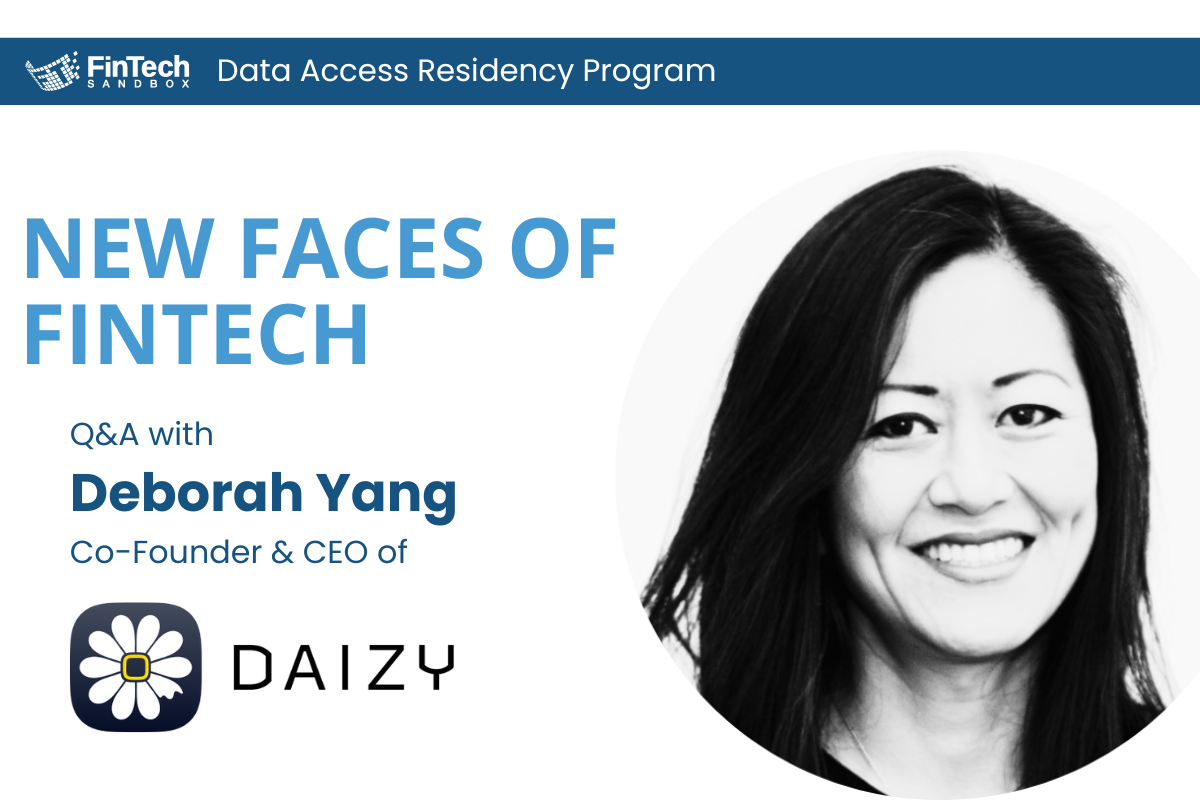
The New Faces of Fintech — Featuring DAIZY

While we may not know exactly how fintech will impact our future, we have an idea as to who will be leading the charge. In the next installments of our ongoing blog series, “The New Faces of Fintech”, we will spotlight some of the emerging leaders in the fintech world to get their thoughts on what the future of the industry will look like.

Their origin stories are different, their paths to entrepreneurship are unique, but their impacts on their respective industries are significant. No one truly knows what the future of fintech holds, but these industry leaders may have an inkling as to what we can expect.

Our next guest is Deborah Yang, CEO & Co-Founder of DAIZY. DAIZY Scribe (currently in private beta) allows you to generate personalized financial content in seconds with compliant data, real-time calculations, and dynamic infographics and do so at scale. Deborah is based in Paris.

Deborah Yang, CEO of DAIZY, is featured in New Faces of Fintech

Deborah, tell us a little bit about your background. What were you working on before founding this company?

Before DAIZY, I was Global Head of Sustainable Indexes at MSCI, leading high-growth franchises including factor indexes, EMEA index, and Asia regions across 18 years. I am also the Co-President of Women in ETFs EMEA.

Tell us a bit about your company? What’s the problem you’re solving?

DAIZY combines compliant financial data, real-time calculation engines, and large language models (LLMs) to bring generative AI solutions to the financial services industry. We enable financial insights and communications production with unprecedented scale, authority, efficiency, and customization.

What’s the origin story behind your company? How and why did you come up with the idea?

We fundamentally believe that the wealth management and broader financial services industry is suffering the consequences of legacy technology and disparate data. The time for firms to make a technological leap is now, and with the adoption of AI there will be massive change and disruption in the industry.

Start-ups are all about the team. Working with Jonty Hurwitz, a veteran tech-founder with a track record including the unicorn FinTech company, Wonga, has been amazing because he is always 10 steps ahead of everyone else in dreaming up “the art of the possible”. We also brought on Jim Wiandt, the visionary behind ETF.com and InsideETFs, because of his deep ties in the wealth and financial services industry. We have the best of the best from seasoned leaders, and we will need to continue to attract the next generation of builders. Together, we have a lot of ideas and potential, but right now we’re laser focused on scalable product-market fit for DAIZY Scribe — our first B2B platform for asset and wealth management firms.

What milestones has your company achieved so far?

We launched our B2B platform beta, DAIZY Scribe, in December 2023.

Immediately after launch, we started running implementations with leading asset management firms and platforms.

We were one of the first investment providers with a plug-in live in the OpenAI plug-in store, seeing huge numbers of queries coming from users.

We have built a team of genuine industry leaders in our business to oversee client implementations and will continue to build to remain agile in this evolving industry.

Can you describe what it’s been like to be part of the Fintech Sandbox community?

As a recent addition to Fintech Sandbox, we’ve already found the experience beneficial. We’ve been impressed with the speed of being able to arrange meetings with partners and the quality of people.

Access to reliable, high-quality data is crucial for the industry. Especially with the widespread concern of ‘hallucinations’ by large language models, we are committed to only using best-in-class data. For financial services firms, trust and accuracy are paramount.

What’s next for your company?

We are highly focused on deepening our scalable product-market fit by adding more Skills for DAIZY Scribe. Our implementations enable us to stay closely aligned with clients’ usage and make direct ties to the amplification of their human capital and revenue growth.

What is some of the best advice you’ve received as a startup founder?

Marc Andreesen famously believes that “only” product-market-fit matters. Though it’s a great point, the question is, how do you get there?

For us, we’re focused on three key areas: 1) building a world-class team by hiring the best talent and ensuring they are agile, 2) listening proactively to clients’ needs and pain points and constantly asking questions, and 3) combining 1 + 2 into a product that adds undeniable value to our clients’ businesses.

We believe we have those pieces at DAIZY, and we know we need to continually prove that. To solve the investing industry’s most daunting problems, first we must earn and maintain our clients’ trust. It’s the only way to bring AI solutions to our industry and generate the ROI we know we can for our clients.

What fintech trends are you most excited about right now?

AI in fintech has captured the industry’s imagination. The adoption of AI in wealth and financial services industry will revolutionize the industry in a way that I have not witnessed in my 25 years in financial services. It will be a step function transformation that will quickly separate the winners and the losers in the space because of the opportunity for massive productivity gains.

Are you hiring?

We anticipate the need for product builders, developers, and client-facing teams as we manage increasing customer demand for our AI solutions.

We’re thrilled to feature some of the incredible entrepreneurs who are participating in our Data Access Residency. If you are aware of any fintech entrepreneurs with an early stage company who could benefit from free access to data, cloud hosting, and a supportive community, please have them visit our website to learn more.

The Fintech 5 with Frazer Anderson — Principal at Vestigo Ventures

The Fintech 5 is a series of blog posts consisting of questions and answers designed to help you get to know the people in the Fintech Sandbox community.

Frazer Anderson is a Principal at Boston-based, fintech-focused venture firm Vestigo Ventures. Vestigo targets initial investment in seed and series A companies. Frazer has a particular interest in how machine learning and SaaS are transforming financial services.

Frazer Anderson
Frazer Anderson

Question #1: Frazer, what fintech problem has your attention right now?

Problems abound! I’m not focused on any one specifically — looking to find excellent founders who want to automate and build analytics on top of existing workflows. If there is one area I would look though it would be platform plays in private markets.

#2: What trends in fintech are you most excited about?

It’s all about AI-driven automation and infrastructure or the API-ification of financial services.

#3: What are some of the biggest learnings from your career journey in fintech and/or entrepreneurship?

Early-stage investing is 100% about the team. Everything else you do as part of diligence ultimately gets back to information about how perceptive, relentless, networked, etc. the team you’re investing in is.

#4: Which fintech companies are you keeping an eye on right now?

SaaSWorks is automating the customer data file and bringing superpowers to the office of the CFO.

#5: Hot take! What are your thoughts on AI in the fintech industry?

Visibility and accuracy are the biggest things holding back the adoption curve. The stakes in financial services are too high to have hallucinations for a lot of tasks and enterprises are going to require visibility into how decisions are made. That’s why there is still plenty of room to build good old-fashioned infrastructure or lean in to super high-value tech-enabled services.

Bonus Question! If you could have coffee with any entrepreneur, who would it be?

Warren Buffet.

If you are a fintech entrepreneur with an early-stage company and you could benefit from free access to data, cloud hosting, and a supportive community, please visit our website to learn more!

The Fintech 5 with Michael Haney — Head of Product Strategy at Galileo Financial Technologies

The Fintech 5 is a series of blog posts consisting of questions and answers designed to help you get to know the people in the Fintech Sandbox community.

Michael Haney heads product strategy for Galileo Financial Technologies. Galileo enables fintechs, banks, and both emerging and established brands to build differentiated financial solutions that deliver exceptional, customer-centric experiences.

Michael has spent his career at the intersection of technology and financial services, frequently driving digital transformation. Last fall, he was on the 2023 Boston Fintech Week stage as a participant in a panel called Laying the Foundation: Digital Infrastructure for Modern Banking.

Michael Haney — Head of Product Strategy at Galileo Financial Technologies
Michael Haney

Question #1: What fintech problem has your attention right now?

The Federal Reserve Bank analysis revealed that most consumers in the Millennial cohort have a high degree of interest in faster payments for both account-to-account (A2A) and consumer-to-business (C2B) scenarios, at 61% and 71% respectively. Two separate studies by Barlow Research Associates and Citizens Bank show that about 52% of businesses also indicate a high degree of interest in faster payments and expect about 22% of their outbound payments to faster payments. As of the third quarter of 2023, 461 financial institutions participate in The Clearing House’s RTP platform, and 331 participate in the Federal Reserve’s FedNow service. Here at Galileo Financial Technologies, we are meeting this growing demand by enhancing our money movement capabilities to support faster payments. Galileo clients of all types, including financial institutions, digital challengers, and even non-financial brands, can leverage this new capability.

#2: What trends in fintech are you most excited about?

(1) The rise of faster payments and its enablement of pay-by-bank services.

(2) The improvement of conversational banking by incorporating generative AI technologies.

(3) Better fraud prevention and detection through broad industry participation in data consortiums.

(4) Increased bank adoption of purchase finance solutions, such as BNPL.

(5) Bank workload migration to the cloud, including core processing.

#3: What are some of the biggest learnings from your career journey in fintech and/or entrepreneurship?

(1) There is no success in this industry without a deep understanding and appreciation for risk management and regulatory compliance.

(2) Surround yourself with colleagues who are smarter than you, complement your skill set, and are at least as equally passionate about the opportunity.

(3) Rebuilding the same capabilities on a modern technology stack is insufficient to succeed; you must offer something new.

(4) There is no straight path to success, but don’t let that detour you from achieving your goals.

(5) Start with a customer pain point or unexploited niche, then grow new offerings quickly and tangentially.

#4: Which fintech companies are you keeping an eye on right now?

Credit, used responsibly, has the power to enhance our lives greatly. However, traditional credit scoring limits individuals from accessing loans and increasingly impacts the ability to rent homes or gain employment. New credit scoring methods improve inclusivity and help create a more complete picture of existing clients already in the lending system. Emerging players for alternative credit scoring include Nova Credit, Zest AI, Altro and Pagaya.

#5: Hot take! What are your thoughts on AI in the industry?

Artificial Intelligence, or AI, is an umbrella term for several technologies that can work together or independently to increase automation, improve user engagement, or uncover insights. The three forms of AI penetrating the financial services industry the most are Robotic Process Automation (RPA), Machine Learning (ML), and Natural Language Processing (NLP). The application of these technologies is almost limitless, ranging from intelligent digital assistants and alternative credit scoring to personalized marketing offers. Financial institutions will improve productivity, increase efficiency, and shift work to more value-added tasks. These technologies continue to improve over time; for example, neural networks enhance ML, and generative AI enhances NLP. We have only begun to leverage the power of AI, and it will shape our industry for years to come. However, safeguards are required to ensure fairness, maintain resiliency, and improve confidence in the output of these solutions.

Bonus Question!

What’s the best career or life advice you’ve received?

Prioritize your health. Without it, you cannot achieve your professional ambitions, support your family, or enjoy your personal endeavors. Do what it takes to keep your energy levels high, your mood elevated, and your enthusiasm sustained.

If you are a fintech entrepreneur with an early-stage company and you could benefit from free access to data, cloud hosting, and a supportive community, please visit our website to learn more!

The Fintech 5 with Elizabeth Thomas – Program Director for Mass. Fintech Hub

The Fintech 5 is a series of blog posts consisting of questions and answers designed to help you get to know the people behind Fintech Sandbox and our Data Access Residency better.

Mass Fintech Hub is a public-private partnership comprising a network of fintech leaders, financial experts, academics, public sector leaders and venture capitalists who empower Massachusetts fintech startups to achieve success. It is an initiative under the Fintech Sandbox umbrella. Elizabeth Thomas joined as Program Director in 2022. Before this she worked in economic development with a focus helping fintech and tech companies scale internationally.

Elizabeth Thomas, Mass Fintech Hub Program Director

Question #1: What is your role with Fintech Sandbox?

Mass Fintech Hub Program Director.

#2: What fintech problem/solution are you focused on or most interested in?

My fintech passion is fintech as a solution for improving consumer financial health. I am thrilled when I learn about a solution tackling common problems such as financial literacy, consumer debt reduction, and credit building from a completely new angle.

In January, I will lead a virtual workshop introducing fintech as a vehicle for improved financial health as part of the Massachusetts Office of Economic Empowerment’s Worth & Wealth Seminars. You can learn more about the workshop here.

#3: What trends in fintech are you most excited about?

I am excited about the increasing fintech adoption and acceleration across industries. What was once a niche vertical is becoming a horizontal category. To quote Fintech Sandbox founder Sarah Biller, “Every company is becoming a fintech company”.

In the last few years, we saw new entrants into fintech from tech giants like Amazon and Google. Now we are seeing embedded finance solutions increasing across industries and platforms. More fintech opportunities will continue to reduce friction, time, and costs and increase benefits for the consumer.

#4: If you could change one thing about the fintech ecosystem, what would it be and why?

Our work at the Mass Fintech Hub is focused on accelerating the Massachusetts fintech ecosystem. We are working to unlock capital for new startups, increase corporate-startup collaboration, increase talent in the ecosystem, and enhance the visibility of the great things already going on in our ecosystem.

If I were to pick one thing to change, it would be to continue to increase opportunities for connections across the ecosystem in support of these goals. In November we released an Ecosystem Reassessment report in partnership with Mass Tech Collaborative authored by KPMG that surveyed the ecosystem to help us find ways to do just that. You can join our growing community and learn how to get involved here.

#5: Hot take! What are your thoughts on AI in the industry? Are we about to see a major transformation beyond chatbots? Is fintech the key to unlocking AI at scale for financial services?

At Fintech Sandbox we interview up to 6 fintech startups a week for the Data Access Residency program. In the last year, the number of startups we have seen with AI tools increasing efficiency, supporting decision-making and customer interaction in financial services has increased exponentially. We have a ways to go, but we are certainly on the brink of an exciting change in the industry.

Bonus Question! What’s the most interesting thing you’ve read recently? 

I’m currently reading the Four Agreements, based on ancient Toltec wisdom and philosophy. My sister had recommended it and in an exciting coincidence,  I subsequently came across it in a little free library stand around the corner from my house. Was it fate?  I find it intriguing to learn how different cultures deal with common philosophical questions about how to live a happy and fulfilled life. And I love the metaphor introduced in the book of every person existing in their own dream that they have the power to change through simple actions.

# # #

If you are a fintech entrepreneur with an early-stage company and you could benefit from free access to data, cloud hosting, and a supportive community, please visit our website to learn more!


The Fintech 5 with Abdul Abdirahman — Principal at F-Prime Capital

In an ongoing series of blog posts, we’d like to introduce you to some of the sponsors, partners, advocates, and entrepreneurs who make up the unique Fintech Sandbox community, and without whom our small team could not provide fintech startups with access to critical data and resources, entirely for free.

Next up is Abdul Abdirahman, a Principal with F-Prime Capital and an erstwhile Advocate for Fintech Sandbox. If you were at Boston Fintech Week in October, you may have seen Abdul demo and launch the newly revised F-Prime Fintech Index during a plenary session. His talk was entitled State of Fintech: F-Prime Capital Fintech Index Highlights.

Briefly, the F-Prime Fintech Index tracks the stock market performance of ~50 emerging and publicly traded financial technology companies, and allows for comparisons between individual companies as well as fintech subsectors such as payments, banking wealth management, insurance, and proptech.

Abdul Abdirahman — Investor of F-Prime Capital
Abdul Abdirahman

Question 1. Abdul, can you tell us about the intent behind the Fintech Index?

The F-Prime Fintech Index was launched as a way to track disruptive, publicly-traded fintech companies. The F-Prime Fintech Index serves as a benchmark for the development of this rapidly maturing sector and closely tracks the leading disruptors.

Q 2. Why is F-Prime Capital, a venture capital firm which invests in private companies at the earliest stages, tracking the performance of publicly traded fintech stocks?

At F-Prime Capital, we are thematic investors who spend a lot of time in the fintech space. We have been investing in this growing sector for more than a decade and, alongside our sister funds at Eight Roads, we have been fortunate to back some large and category-defining disruptors including Alibaba, Toast, Quovo/Plaid, Fireblocks, Flywire, and many more. As investors, we closely monitor public markets to inform our thinking across different fintech sub-categories and understand what potential exits might look like. This process often involves pulling revenue multiples, financial metrics, and other non-financial data. These data points — and the insights we compile in our newsletter and State of Fintech reports — can be useful to entrepreneurs, operators, and fellow investors who want a real-time window on the market.

Last year we went a step further and added vertical-specific benchmarks. These benchmarks go a level deeper than top-line metrics (such as revenue, growth rate, and multiples) and capture vital metrics that require digging into public and private reports. For example, if you are building in the payment space, wouldn’t it be great to see how take rates are trending, and which companies are garnering the highest take rates? The F-Prime Fintech Index now lets you do that — and much more.

Q 3. What should we know about the new Fintech Index functionality?

The new functionality on the Fintech Index includes:

  1. Company and sector comparison by revenue, growth, margin, multiple, and more,
  2. Adaptive visual multiples and benchmarks
  3. Head-to-head company comparisons
  4. Adaptive sector- and vertical-specific benchmarks
  5. Time series of historical metrics by sector and revenue growth

To learn more about how to use the new-look F-Prime Fintech Index, check out this brief video overview. Additionally, the October 2023 edition of our Fintech Prime Time newsletter demonstrates how we’re using these new tools in our own industry analysis.

Q. 4. What are the most interesting insights you’ve recently gleaned from the Index?

There are three fintech disruptors with market caps of $50B+, and they have very different revenue profiles. As a result, they garner very different multiples to get to the $50B+ valuation. Vertical SaaS company Shopify has revenues of $6.7B and an LTM revenue multiple of ~14x, whereas payment companies PayPal and Mercado Libre have LTM revenues of $29B and $13B respectively, along with LTM revenue multiples of 2.4x and 6x. Investors love a good SaaS + payments business, and Shopify delivers, 29% and 71%, respectively.

Q 5. Do you have any predictions for the state of fintech in 2024?

The overall climate for fintech in 2023 was “regulation on, risk off” with heightened scrutiny, rule-making, and enforcement by regulators. We will continue to see increased regulatory scrutiny in 2024. However, we also think the fintech correction in private markets will stabilize in the new year. Our full State of Fintech report will be launched soon — sign up for our fintech newsletter to gain access when we release it in February.

Bonus Q 1. Why did you choose to launch the revised Fintech Index during Boston Fintech Week?

As a Boston-based firm with a strong partnership with the Fintech Sandbox, we were happy to launch the new-look F-Prime Fintech Index at Boston Fintech Week. Boston has a great fintech community of founders, operators, investors, and other folks in the financial services ecosystem, and we know the Index has many fans among them. We received a lot of positive feedback on the changes, and always welcome suggestions from our Boston Fintech community.

Bonus Q 2. What impact do you think GenAI will have on wealth management?

Within fintech, one of our key investment areas is wealth and asset management. We think there are many opportunities for GenAI to have an impact in this arena, especially when it comes to how financial advisors work with their clients. In short, we believe GenAI will act more like a co-pilot than a driver for fully autonomous finance in the wealth management sector — at least in the short-to-medium term. If you’re interested, a recent edition of our fintech newsletter delved into this topic.

# # #

If you are a fintech entrepreneur with an early-stage company and you could benefit from free access to data, cloud hosting, and a supportive community, please visit our website to learn more!

The Fintech 5 with Kathryn Van Nuys — Advisory Board Member at Fintech Sandbox

The Fintech 5 is a series of blog posts consisting of questions and answers designed to help you get to know the people behind Fintech Sandbox and our Data Access Residency better.

Kathryn Van Nuys is the Head of Startup Business Development for North America at Amazon Web Services (AWS) and an Advisory Board member at Fintech Sandbox. She began her career with more established financial services firms before working at several capital markets focused fintech startups. She joined AWS in 2018.

AWS has several programs designed to help entrepreneurs bring their ideas to market and makes these programs, which include credits for their cloud hosting platform, available to startups selected for our Data Access Residency free of charge.

Kathryn-Van-Nuys

Question #1: Why has AWS chosen to support Fintech Sandbox in this way?

We have been working with the Fintech Sandbox for many years and it’s been a great relationship. A core part of our strategy is to work with partners including VCs, accelerators, and incubators to ensure startups get the guidance, support, and infrastructure they need to build disruptive businesses. AWS provides programs like Activate, which helps them get off the ground with business and technical expertise, and credits to test and start building solutions with little to no upfront costs. We also work with startups as they leverage the AWS Partner Network and Marketplace, which helps them market their products and services to potential customers and generate business leads. Fintech Sandbox has a similar customer obsessed approach in their support of Fintech entrepreneurs as they provide access to data which is critical to the building and testing of their products. 

Question #2: Hot take! What are your thoughts on AI in the financial services industry?

Today, 91% of financial services institutions are using artificial intelligence (AI) to drive business transformation and change, and 80% of fintechs are leveraging machine learning (ML) in particular. AI is already pervasive and generative AI will take it to a different level which can change the game for financial services. We are still in the very early innings and so far we are seeing generative AI being used to make chatbots like Cleo more sophisticated and easy to use, to automate individualized financial analysis and investment recommendations, and to expand access to services, such wealth management and business bookkeeping.

At AWS, we are betting big on generative AI because we believe in its potential to usher in the era of ‘self-driving money’, when every consumer with a smartphone can have access to an affordable, trusted financial advisor that will help them improve their financial health. In a future where access to finance is set to be cheaper, greener, and decentralized, arming fintechs with these powerful tools and new technologies unlocks new opportunities for them to delight customers.

We also see a big opportunity in code development. This is not unique to financial services, but we are certainly seeing a lot of Fintechs and financial institutions use Amazon CodeWhisperer to boost developer productivity, code quality, and accelerate workload production. 

Question 3: How does AWS facilitate the development of fintech startups that are leveraging AI?

More fintechs around the world trust AWS to build their solutions—AWS runs more secure workloads for financial services than any other cloud provider and offers unmatched reach. Building on AWS enables fintech startups to be data-driven and AI-ready from inception, helping them innovate quicker and get to market faster. With 70+ state-of-the-art services for big data analytics, artificial intelligence and machine learning fine-tuned over two decades of experience, AWS has the broadest and deepest solution set to help fintechs make better decisions faster and provide outstanding, personalized services to their customers.

Our account support team, from go-to-market to solutions architecture, is completely verticalized to meet the specific needs of fintechs—with seasoned financial services experts that really understand what it takes to be successful in a such a heavily regulated industry. We also have a team of machine learning and artificial intelligence experts ready to support startup customers think through their use cases and learn best practices. We have also developed programs such as the Global Fintech Accelerator which is aimed at turbocharging growth for fintech startups leveraging AI and machine learning. We consistently hear from customers that our support and specialized knowledge is incredibly helpful as they grow their business and is a real differentiator. 

Question 4: How has your experience working at fintech startups informed what you do now at AWS?

Having the experience of working at both large financial institutions as well as fintech startups provides me with a deeper understanding of our customers and the pain points they are looking to solve. At AWS, we understand that success takes more than just having a great idea – it also requires the right tools, expert advice, and supportive partnerships. That’s why we have built a team with deep industry experience who use customer feedback to build programs and resources to support customers. 

Question #5: What are some of the biggest learnings from your career journey?

In my career, I’ve found that continuous learning, adaptability, and effective communication are crucial if you want to grow and evolve your career. As we’ve seen with generative AI more recently and before that Web3, staying curious will help keep your skills relevant and demonstrates an innovation mindset. 

Bonus Question: What’s the most interesting thing you’ve read recently?

I’ve been trying to learn as much as I can about artificial intelligence and recently read Chip Wars. If you’re interested in understanding more about the history of microchip technology, definitely check it out.

The Fintech 5 with Kelly Fryer — Executive Director of Fintech Sandbox

Kelly-Fryer

Question #1: What is your role with Fintech Sandbox?

I’m Executive Director, or nonprofit speak for CEO. I’ve been leading the company for the last 3 years, joining in September 2020. My day-to-day focuses on a wide range of overall company strategy, program operations, and relationship management across the company as well as for each of the programs under the Fintech Sandbox umbrella – our flagship Data Access Residency, Boston Fintech Week, and Mass Fintech Hub. 

Fun Fact: While Fintech Sandbox is headquartered in Boston, I’m actually based in the New York City area. Boston has definitely become a second home at this point! 

#2: What trends in fintech are you most excited about?

Through Fintech Sandbox’s Data Access Residency, we have seen a big uptick in startups requesting private company data and solutions focused on that space, which I’m very happy to see. The applications range from verifying small business data, M&A deal sourcing and discoverability, unique private market funding and investment models, and more. As we see changes in the startup and VC landscape over the past year or so, this trend seems to be a direct reflection on the concerns and challenges of the private markets for both entrepreneurs and investors.

#3: What are some of the biggest learnings from your career journey in fintech and/or entrepreneurship?

On the fintech front, there are many – and incredibly important – problems that fintech still needs to solve! While we hear a lot of talk about fintech slowing down, I don’t see how it can. There are still too many core global challenges within our financial systems and across the multitude of ways that people engage with money (saving, lending, investing, etc.), and only powerful, innovative technologies will solve them. 

On the entrepreneurship front, never underestimate the value of the basics. Being able to simply and succinctly explain what the company or product actually does is essential and square one. Your next door neighbor or your grandma should be able to follow along and understand what your business does after your brief explanation. I’ve heard very complex derivatives solutions explained clearly in less than 2 minutes, and I’ve also gotten confused listening to a 30-minute explanation of a very simple PFM. It’s challenging to move the conversation forward if we haven’t moved past those basic pieces yet. Also, don’t forget to introduce yourselves and your team too! Remember: people invest in people, so tell a story and create that connection.

#4: Hot take! What are your thoughts on AI in the industry? Are we about to see a major transformation beyond chatbots? Is fintech the key to unlocking AI at scale for financial services? Overrated or underestimated? We want to hear your thoughts!

It’s funny to me because it feels like we’ve been talking about and seeing AI for the past decade or so. But, now that OpenAI and ChatGPT have gone mainstream and more Generative AI models are being built, these conversations about AI as a new emerging technology have resurged. Maybe now it’s finally being considered as a truly transformative technology. 

There are unlimited potential solutions that AI infrastructure could enable, and I am excited by those possibilities especially for more inclusive decision making. But actual adoption and implementation will still be slow, as all firms are still figuring out the potential risks and regulations for AI. My concern on the topic of AI is always ethics and very intentional awareness when utilizing it. AI has the power to remove many human biases from key financial decisions and build transparency, but it also has the power to increase bias exponentially and be a black box. Plus, there are a number of other major questions that still remain with AI – IP, privacy, and much more.

#5: What’s the most interesting thing you’ve read recently?

Does listening count? Between planes, trains, and cars, I tend to do more audiobooks these days. 

I recently finished a book called Tomorrow and Tomorrow and Tomorrow about the evolving friendship of two video game designers as they fall in love with games as kids to starting their own gaming empire to the normal challenges of becoming adults. Looking at my own career, I especially found it to be an interesting perspective on entrepreneurship and the difficult choices that teams have to make to reach success, as well as the challenging dynamics women face as their careers advance. Recommend!

The Fintech 5 (plus 3) with Adam Broun — Advisory Board Member at Fintech Sandbox

The Fintech 5 is a series of blog posts consisting of questions and answers designed to help you get to know the people behind Fintech Sandbox and our Data Access Residency better.

adam-broun

Adam Broun is a member of the Advisory Board of Fintech Sandbox as well as Chairman of Secondmind, a startup using machine learning to improve the process of designing automobiles. 

Previously, he was CEO of Kensho Technologies, an AI company that continues to build solutions to uncover insights in unstructured data that enable critical workflows and empower businesses to make decisions with conviction. Kensho was an early participant in our Data Access Residency. S&P Global acquired Kensho in 2018 for $550 million.  Prior to that he was CIO, Front Office and global head of IT Strategy at Credit Suisse, and a partner in Deloitte Consulting’s financial services practice.

The use of AI in financial services isn’t new. AI startups have been coming to Fintech Sandbox for access to training data from our very beginning. But recently, generative AI has been garnering significant attention. Generative AI is a specific subset of AI and machine learning capabilities distinguished by its ability to create new data, images, text, or other types of content. Given his experience, we thought Adam would be a good person to ask a few questions.

Question #1: Adam, Kensho was one of the very first startups accepted into the Fintech Sandbox Data Access Residency when we were starting out in 2015. What did Kensho gain from participation in the program?

When Kensho joined the Boston Fintech Sandbox it was still in a very early stage. But we were able to work with several data vendors to accelerate acquisition and evaluation of data that helped us launch the first version of the platform quickly and gave us some of the connections to be able to negotiate more strategic deals as the company evolved.

#2: Why have you chosen to remain involved with Fintech Sandbox?

I never stopped being involved with the Fintech Sandbox. I love being involved in the Boston and broader fintech ecosystem partly for my own curiosity but mostly because it’s an opportunity to help emerging companies transform the financial services industry.

#3: In your opinion, which is the most compelling use case for generative AI in financial services?

I think there are lots of compelling use cases for generative AI in financial services.  Some obvious ones include internal productivity measures like code generation and code review as well as customer facing applications like chat bots. But the more interesting applications probably come when generative AI is used for more specific applications such as helping analysts ask and answer questions about the world. This was always part of Kensho’s original mission, but the emergence of Large Language Model (LLM) technologies has supercharged the ability for startups and institutions to realize that vision and create “digital assistants” that can help financial analysts make sense of the world around them ask and answer intelligent questions and make decisions faster and with more certainty than before.

#4: Are small and midsized financial services firms going to be able to build proprietary generative AI capabilities in-house or will they be better off partnering with AI startups?

It’s interesting because the technology to create generative AI capabilities is incredibly accessible. Almost anyone with a basic coding background and a little bit of time and curiosity can leverage the existing tools to create some amazing solutions. But the complexity arises from the availability of high-quality training data specific to the use case, ensuring that the answers provided are true and not hallucinated, integrating the technology into the workflow of those who will benefit from it, and guarding against unintended vulnerabilities or side effects which arise from the inherent complexity of these tools and the unpredictability of their behavior.

#5:  Given the need for financial institutions to be able to explain their decisions, can generative AI be used to “make” credit decisions or fulfill regulatory requirements related to, say, KYC/AML? Or is its opacity an insurmountable hurdle?

In situations like KYC/AML or credit decisions, generative AI is probably not the right technology to sit at the core of those processes.  Partly that’s because of explainability, as you say, but it’s also about predictability: given the same facts you want the technology to produce the same results every time. Generative AI by its nature includes a degree of randomness that’s highly undesirable in these cases. But there may well be a role for generative AI on either side of those processes, for example to help explain or create a narrative around a decision given a set of facts that can help a salesperson or customer service agent as they interact with a customer. Or you could imagine a generative AI application assisting a customer directly in assembling the information required for an onboarding or credit decisioning process.

#6: What are the biggest risks arising from the use of generative AI in financial services? What do you worry about?

I think there are a few risks that institutions need to be paying attention to.  Perhaps the most obvious is the tendency for large language models to hallucinate, i.e., be confident but wrong about statements they’re making, which is clearly unacceptable if a business decision is going to be based on them. LLMs being used in this type of application are not only going to have to be trained on extremely high-quality data, but they will also have to be adapted to provide traceability of every assertion they make back to trusted source data and that’s going to require some heavy-duty integration from the user interface back to large trusted data sources. A second area of risk arises from the provenance of data being used to train the models. Institutions need to be extraordinarily careful that the data they use is (1) permissible to be used in training and (2) not confidential to the extent that if a model can be prompted to regurgitate that data it does not compromise any privacy or confidentiality concerns.

#7: How do we make sure historical biases are kept out of the data used to train large language models and away from the processes and algorithms used in generating AI responses?

I don’t believe you can! Given the enormous amount of training data required for these models, you’re ingesting a huge amount of historical information which is inherently going to reflect whatever biases, conscious or unconscious, were prevalent at the time. That can show up in quantitative training data such as credit decisioning or in the type of language used in textual reports or other documents. I think the best you can do is be very thoughtful about where the technology is going to be used and do your best to apply corrections to the training data or fine tune the outputs to correct for those biases going forward.

#8: Criminals will make use of generative AI as well. What are the implications for FSIs?

Anytime new technology is deployed, it creates new attack vectors for bad actors. Generative AI creates all kinds of opportunities like this including creating bots that can impersonate customers to fool institutions, or pretend to be institutions to fool customers, at scale and very cheaply.  Given that audio and video can be generated as well as text, it’s not hard to imagine how extremely sophisticated attacks could be constructed. Another area for institutions to be concerned about are adversarial attacks on their generative models. Here for example is a recent paper that shows how adding carefully selected strings to a prompt can cause a publicly available LLM to reply with information that it’s been explicitly told not to.  It’s not hard to see that this could be extended so that potentially with the right adversarial prompt a bank’s LLM would respond with inappropriate personal information.  Institutions are going to have to be extraordinarily vigilant about these new attack vectors and probably create additional layers of surveillance before they can allow these sorts of technologies in customer-facing applications.

A Few Questions about Fundraising with Data Advocate Sarah Lamont

Over the next few months, we’d like to introduce you to some of the sponsors, partners, advocates, and entrepreneurs who make up the unique Fintech Sandbox community, and without whom our small team could not provide fintech startups with access to critical data and resources, entirely for free.

First up is Sarah Lamont, a Data Advocate who helps us evaluate startups that have applied for admission to our Data Access Residency. Her day job is as an investor at Fintech Sandbox sponsor F-Prime Capital.

While most startups apply to Fintech Sandbox before speaking to venture capital firms, raising a seed or Series A is usually high on their list of things to do, so we thought we’d ask Sarah to provide some guidance that might be particularly helpful to first-time entrepreneurs who have not had to raise venture capital before.

sarah-lamont

Sarah, thanks for talking to us today. First off, can you tell us why you volunteer your time as a Data Advocate?

Financial data is expensive! i.e., cost-prohibitive for startups who are caught in the catch-22 of ‘need money for data, need data to build my product, need product to raise money’. So I volunteer time as a Data Advocate to help funnel early-stage companies into the Sandbox and get their product off the ground, and because it gives me the chance to meet entrepreneurs when they’re still in build-mode, outside of the fundraising context.

Can I ask a venture firm to sign an NDA before I send them my pitch deck?

It’s highly recommended to not do this (and doing so is a bit of a yellow flag). Investors may be reviewing hundreds or even thousands of pitch decks per year, and signing an NDA for each would be putting undue stress on their legal teams. Consider lighter weight options for staying in control of who sees your pitch deck e.g., email/password requirements or link expirations.

Who should pitch the company when meeting with a VC? Just the CEO? The whole founding team? Important team members who are non-founders?

There’s no hard and fast rule, but the first meeting should be 1-2 (co-)founders. Investors will want to meet the rest of senior leadership (e.g., product, marketing) at some point during the diligence process, but those meetings can be scheduled separately after a first few conversations.

Say we’re a B2B startup and several firms are already using our software. At what point in the process should I let a potential investor talk to my clients?

You want to be respectful of your customers’ time and ask for minimal favors, but also recognize that voice of the customer is one of the more important data points for early-stage investors. You should save the customer introductions until investors have given you the signal that they’re nearing the end of their diligence process and trending positively towards a term sheet.

How do you place a value on a startup that’s pre-revenue?

It’s a bit more art than science (and becomes more science than art in later stages). Most go the route of considering qualitative factors – like founding team, opportunity size, existence of early pilots – while also weighing quantitative considerations like expected exit value and return on investment.

Is there a danger you can over-inflate your seed stage valuation?

Yes. An over-inflated seed stage valuation puts you in a more difficult spot to raise funds at later stages, as investors will hesitate on price unless you have significant traction to justify the valuation.

When should I ask an investor for introductions to CEOs of their portfolio companies so I can do my own due diligence?

This is a great step to take during the diligence process. You should take this step when you’re nearing a term sheet, or when investors are asking for introductions to some of your most valuable customers (which, as mentioned previously, should also ideally be towards the end of the process).

If we pitched a venture fund that really liked us but decided to pass for whatever reason, should we ask them to introduce us to other VCs? Or will other VCs be less interested because the first VC passed?

Introductions to other VCs is one of the quicker-wins you can get out of VCs, and in most cases you can and should ask for them. If the pass is due to stage or sector, they can help you identify VCs whose fund mandate is more aligned to your company and get you a warm introduction.

Are there any other tips you’d like to pass to first-time founders on pitching a venture capital firm?

Investors will have varying preferences on whether they want to walk through a deck or keep it more conversational, Q&A style. Get a feel for that upfront and adjust the pitch accordingly.

As for landing a meeting, don’t feel compelled to meet every VC through a warm introduction. Cold outreach works – but do make sure the message is tailored to that investor or fund specifically. It doesn’t send a good signal when you send a seed-stage fintech deck to a growth-stage healthcare investor.